%20(1).webp)
Beth Raboin
CEO & Founder | GMVA

Healthcare organizations are operating with too few people trying to do too much administrative work. These staffing shortfalls are nothing new. They’ve been an issue since before COVID-19. However, what’s changed over the past few years is that the usual “fixes” aren’t working well enough anymore.
Hiring more full-time administrative staff used to be the industry default. But without enough candidates in the market, and admin turnover between 30% and 40% annually, hiring more FTEs has virtually no chance of working long term. Getting stuck on the hamster wheel of hiring and rehiring likely creates more work and headaches than it solves.
Staffing agencies can fill short-term needs. They’re useful when someone’s out sick or a specific project needs an extra set of hands. They’re not meant to buoy a department through an administrative workload that keeps getting bigger and more complicated.
GMVA is built for that assignment. We’re a workforce infrastructure partner for hospitals, health systems, and large practices. Our specialists plug into an organization’s EHR and existing workflows to become an “insourced” extension of the team. Capacity goes up, but headcount and fixed costs do not. And for 62% less than it costs to hire FTEs.
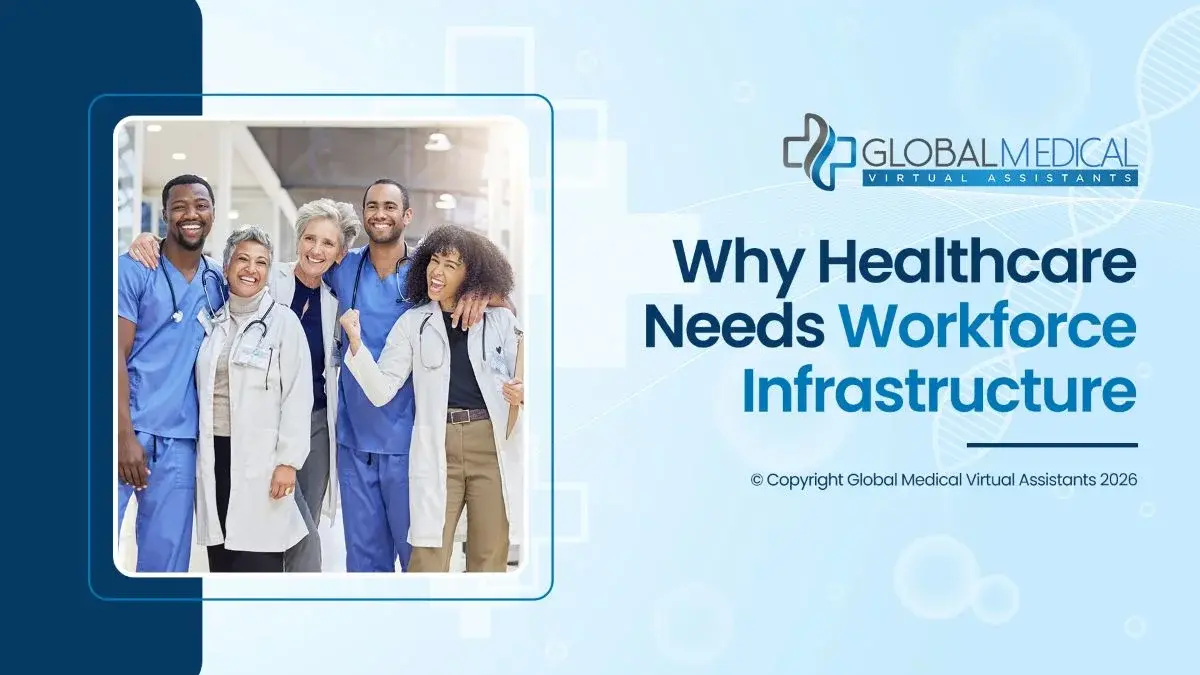
Workforce infrastructure isn’t about filling open positions, though that’s certainly a benefit. It’s about embracing a new model that fits where the administrative function of healthcare is going, not where it’s been.
What Separates Workforce Infrastructure from Traditional Staffing
Even though people often mix them up, staffing and workforce infrastructure are actually quite different.
When we talk about staffing, the question is: "Who can fill this position?"
On the other hand, workforce infrastructure asks: "How can we make this function run as smoothly as possible?"
Staffing is all about the labor supply, while workforce infrastructure zeroes in on how operations are designed. Staffing typically deals with filling immediate vacancies, whereas workforce infrastructure looks at the bigger picture of long-term organizational performance.
In today’s healthcare landscape, both are essential. However, organizations that only concentrate on staffing might overlook chances to truly enhance how work is accomplished.
The most successful health systems aren’t just bringing in more people; they’re rethinking workflows, optimizing their resources, and creating support structures that can grow with them. That’s what workforce infrastructure is all about.
Workforce Infrastructure Partnership is Not Outsourcing
When we think of traditional outsourcing, it often revolves around cutting costs or replacing a specific function with external help. This kind of relationship tends to be transactional, focusing on getting tasks done rather than transforming operations. But a workforce infrastructure partner takes a different approach.
Rather than just supplying workers, they help build the systems, workflows, support structures, and operational capacity that healthcare organizations need to thrive. The aim isn’t to replace existing healthcare teams; it’s to empower them.
These partners collaborate closely with hospital leadership to pinpoint operational bottlenecks, administrative burdens, workflow inefficiencies, staffing shortages, and scalability issues. From there, they craft a sustainable support model that seamlessly integrates with current operations.
Often, this involves creating dedicated teams that act as extensions of the health system itself. These professionals become woven into the fabric of workflows, technologies, processes, and performance expectations. They align with organizational goals instead of just filling in gaps.
The distinction here is crucial. One approach addresses a temporary staffing issue, while the other builds lasting operational capacity.
See how GMVA’s model provides a much-needed bridge between administrative workloads and capacity: https://gmva.com/.
.jpg)
.webp)