


Preston Strada

For healthcare organizations, managing the revenue cycle is about more than submitting claims and collecting payments. It's about ensuring that services are properly documented, claims move through the reimbursement process efficiently, and outstanding revenue doesn't become trapped in administrative backlogs.
But as payer requirements grow more complex, revenue cycle management (RCM) teams are being asked to accomplish more with limited resources.
Prior authorization delays, denied claims, unpaid accounts, and time-consuming payer follow-ups can create operational bottlenecks that affect cash flow and place additional pressure on existing staff.
According to the 2026 Guidehouse/HFMA Revenue Cycle Management Trends Report, 88% of healthcare executives ranked payer-related challenges among their top three revenue cycle concerns. The report identified increased denials, authorization delays, documentation requests, and reimbursement challenges as significant contributors to those concerns.
For practice administrators, CFOs, and RCM leaders, the question is increasingly about capacity: How can organizations manage growing administrative demands without continuously expanding their internal workforce?
One approach is integrating medical virtual assistants into revenue cycle management workflows.
By assigning trained virtual professionals to specific administrative functions, healthcare organizations can extend the capacity of their existing RCM departments, address outstanding work queues, and give experienced internal personnel more time to focus on complex issues.
The value isn't simply having additional people available. It's making sure the right work is being completed by the right people, at the right time.

Why Revenue Cycle Management Teams Need More Operational Support
Every stage of the revenue cycle influences an organization's financial performance.
An eligibility discrepancy before an appointment can lead to a denied claim. An authorization request that isn't followed through can delay treatment or reimbursement. An unpaid claim that sits untouched for weeks can become increasingly difficult to resolve.
Individually, these may appear to be routine administrative issues. Across hundreds or thousands of patient encounters, however, they can create substantial financial and operational challenges.
The difficulty is that many RCM processes require consistent follow-through rather than highly specialized decision-making.
Activities such as checking claim status, contacting insurance companies, monitoring outstanding authorizations, obtaining missing information, and updating patient accounts are necessary for revenue cycle performance. Yet they also consume hours that experienced billing specialists, revenue cycle managers, and other internal personnel could spend resolving more complex problems.
This creates an important distinction between staffing costs and workforce capacity.
An organization may have highly capable employees but still lack the bandwidth to complete every necessary follow-up on time.
Medical virtual assistants provide an additional administrative support layer that can help organizations address that gap without requiring every additional task to be assigned to an in-house employee.
How Medical Virtual Assistants Support the Revenue Cycle
Medical virtual assistants can support different stages of revenue cycle management, from financial clearance before a patient's visit to resolving unpaid claims after services have been delivered.
The specific responsibilities depend on the organization's systems, workflows, training requirements, and internal approval procedures.
1. Insurance Eligibility and Benefits Verification
Some of the most expensive revenue cycle problems begin before a claim is ever submitted.
Incorrect insurance information, inactive coverage, missing benefit details, and overlooked authorization requirements can create payment delays and avoidable denials.
Medical virtual assistants can support front-end revenue cycle operations by:
- Verifying active insurance coverage before scheduled appointments.
- Confirming relevant benefits and coverage details.
- Identifying copayment, deductible, and coinsurance information.
- Checking whether specific services require prior authorization.
- Documenting verification findings in the organization's EHR or practice management system.
- Flagging coverage discrepancies for internal review.
For organizations managing high patient volumes, dedicated support can help reduce the administrative burden associated with completing these checks consistently.
2. Prior Authorization Management
Prior authorizations are another major source of administrative work.
Requirements vary across payers, plans, and services. Staff may need to gather documentation, submit requests, check authorization status, and communicate with both payers and clinical teams before services can proceed.
Medical virtual assistants can support this process by tracking outstanding requests, confirming payer requirements, gathering administrative documentation, following up on pending submissions, and communicating status updates to the appropriate internal teams.
Clinical determinations, medical necessity documentation, and other decisions requiring licensed or qualified personnel remain with the appropriate professionals.
The objective is to prevent authorization requests from sitting unnecessarily in work queues because no one has the capacity to follow up.
For example, an organization might assign a medical virtual assistant to monitor authorizations for procedures scheduled within the next seven days, prioritize requests approaching service dates, and escalate issues that require immediate attention.
This creates more consistent visibility into outstanding requests and can help reduce avoidable scheduling and reimbursement disruptions.
3. Claims Follow-Up and Accounts Receivable Management
One of the most direct applications of medical virtual assistants in RCM is supporting accounts receivable (A/R) follow-up.
When a claim remains unpaid, someone must determine why.
The payer may still be processing it. Additional documentation may be required. A claim may have been rejected, denied, or processed at an unexpected reimbursement amount.
Without consistent follow-up, these accounts can accumulate and create growing A/R backlogs.
Medical virtual assistants can help by:
- Reviewing outstanding claims in assigned A/R work queues.
- Contacting payers or checking portals for claim status.
- Identifying missing information or unresolved claim issues.
- Recording payer responses, reference numbers, and next steps.
- Following up on claims requiring correction or additional documentation.
- Escalating complex disputes, underpayments, and other issues to experienced billing personnel.
This allows organizations to establish a more systematic approach to working outstanding accounts rather than relying exclusively on internal staff to manage every inquiry.
4. Denial Management and Appeals Support
Denied claims create additional administrative work and can contribute to revenue leakage when issues aren't identified and addressed promptly.
Some denials involve straightforward administrative discrepancies, while others require detailed reviews of coding, clinical documentation, contract terms, or payer policy.
Medical virtual assistants can support denial management by researching denial reasons, requesting missing information, organizing documentation, monitoring appeal deadlines, and tracking the status of submitted corrections or appeals.
Coding changes, clinical justifications, and other specialized decisions should remain with appropriately qualified personnel.
The benefit is a clearer division of responsibilities.
An experienced denial specialist can concentrate on determining the appropriate resolution while administrative support helps ensure that documentation, follow-up, and status tracking continue moving forward.
Over time, consistent categorization of denials can also help leadership identify recurring problems that should be corrected upstream.
5. Payment Posting, Patient Billing, and Collections Support
RCM responsibilities continue after claims are processed.
Payment reconciliation, patient balances, billing questions, and outstanding collections activities all require attention.
Depending on the organization's procedures and access controls, medical virtual assistants can assist with routine payment posting, identifying discrepancies, supporting patient billing communications, updating account records, and following up on outstanding balances.
These functions help ensure that administrative work doesn't accumulate at the final stages of the revenue cycle.
For RCM leaders, the relevant outcomes may include reduced posting delays, fewer unresolved account discrepancies, and better visibility into outstanding patient balances.
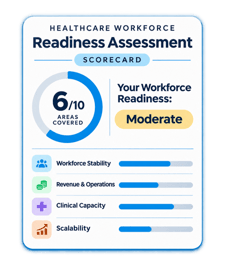
Are Revenue Cycle Bottlenecks a Sign of a Bigger Workforce Gap?
Eligibility verification delays, outstanding claims, and growing administrative backlogs can signal deeper capacity challenges. Find out where your organization's workforce may be under pressure.
Integrating Medical Virtual Assistants into an Existing RCM Team
One common misconception is that using virtual assistants for revenue cycle management means outsourcing the entire billing function.
That isn't necessarily the case.
A dedicated medical virtual assistant can become part of an organization's existing operating model, supporting defined responsibilities while internal managers retain oversight of processes, priorities, and financial performance.
For example, a revenue cycle department might assign its medical virtual assistant to insurance verification and routine A/R follow-up, while experienced in-house employees remain responsible for complex denials, payer disputes, coding reviews, and revenue cycle strategy.
A successful implementation should begin with clear expectations.
Five Steps to Getting Started
1. Identify the operational bottleneck. Determine where work is accumulating and which tasks are consuming staff time without requiring specialized decision-making.
2. Define responsibilities and escalation procedures. Establish exactly which activities the virtual assistant can complete independently, which require approval, and when issues must be escalated.
3. Establish secure access and workflows. Provide appropriate training, role-based system access, documentation standards, and safeguards for protected health information.
4. Set measurable performance expectations. Define the volume, turnaround, accuracy, and financial indicators that will be used to evaluate performance.
5. Review and refine. Monitor early results, address recurring issues, and expand responsibilities only when workflows are operating reliably.
For healthcare organizations, compliance and security should be part of the implementation process from the beginning. Depending on the relationship, a business associate agreement (BAA), appropriate access controls, and other HIPAA safeguards may be required.
At Global Medical Virtual Assistants (GMVA), our model is built around dedicated healthcare administrative professionals who integrate into client workflows, with onboarding, management support, and ongoing performance oversight.
This approach provides organizations with additional administrative capacity while maintaining full operational control.
The Next Evolution: Medical Virtual Assistants and RCM Automation
Technology is changing how revenue cycle departments manage repetitive administrative work.
According to an October 2026 MGMA Stat poll, 63% of medical group leaders reported moving toward greater revenue cycle automation, with coding, prior authorization, denial management, and payment posting among the areas being addressed.
However, automation doesn't eliminate every administrative challenge.
Payer systems can be inconsistent, information may be incomplete, and some cases require clarification, escalation, or professional judgment.
For many organizations, the opportunity is to combine automation with skilled administrative support rather than viewing them as competing approaches.
Automated systems may perform repetitive data handling, initiate payer interactions, or accelerate routine tasks. Medical virtual assistants can monitor workflows, verify information, handle exceptions, and coordinate the next steps required to complete the process.
At GMVA, this approach is reflected in Vera, our agentic AI solution for insurance benefits verification. Vera handles complex payer verification calls while trained medical virtual assistants provide human oversight, review information, and step in when needed.
The objective is to expand administrative capacity without removing the accountability and human judgment that healthcare operations require.
The industry is also preparing for changes in electronic prior authorization. Under the CMS Interoperability and Prior Authorization Final Rule, impacted payers are generally required to implement new prior authorization APIs beginning in January 2027.
As these capabilities develop, healthcare organizations will need to evaluate how automated transactions, existing EHR workflows, and human support fit together.
Frequently Asked Questions
Can medical virtual assistants help with medical billing?
Yes. Depending on their training, assigned responsibilities, and the organization's procedures, medical virtual assistants can support administrative billing functions such as claim status follow-up, payment posting, patient billing communications, and outstanding account management. Specialized coding, clinical, and other regulated decisions should remain with appropriately qualified personnel.
Can medical virtual assistants improve accounts receivable performance?
They can help address common administrative barriers to timely payment through consistent claim follow-up, documentation, payer communication, and work queue management. Actual improvements should be measured using A/R aging, claim resolution, cash collections, and other defined indicators.
Are medical virtual assistants a replacement for an internal RCM department?
Not necessarily. Dedicated virtual assistants can complement existing billing and revenue cycle personnel by assuming defined administrative responsibilities. Internal leadership can retain control over workflow priorities, financial strategy, and complex decisions.
How should a healthcare organization evaluate medical virtual assistant performance?
Start with the outcomes associated with the assigned work. For insurance verification, monitor turnaround time and eligibility-related denials. For A/R follow-up, track claim resolution, aging, and collections. Include quality, accuracy, and compliance measures alongside productivity.