
Beth Raboin
CEO & Founder | GMVA

Hospitals are good at getting administrative work done, no matter what. In between tending to patients, a nurse might call an insurance company. A supervisor covers the front desk at lunchtime, and the billing team extends its workday, almost every day, just to keep up with the volume of denials coming in.
For several years now, there haven’t been enough trained admin professionals in the market to hire, so all of these extras are needed to keep the administrative pipeline moving. The willingness to put in extra effort and overtime is admirable, but not sustainable.
When the chipping in and workarounds run out, patients are forced to wait, bottlenecks increase, and revenue goes uncollected. Fixing these issues takes a strategic plan that goes beyond duct-taping capacity together, especially with Medicaid changes arriving January 1 that will make doing whatever it takes even harder.
Here are five things hospitals need to do to build flexible and sustainable administrative capacity.
1. Step Off the Rehiring Treadmill
Hospitals lost 18.5% of their staff in 2025, according to NSI Nursing Solutions’ 2026 retention report. Year-one turnover is especially alarming: 29.5% of new hires were gone within 12 months. Over five years, the average hospital has turned over 106% of its workforce.With numbers like those, it’s no wonder hospitals constantly recruit, hire, and scramble to fill open administrative roles. In a 2026 Experian Health survey, 64% of providers said staffing shortages are making it harder for patients to get care, up from 57% a year earlier.
The old standby of hiring more full-time staff to fill administrative openings doesn’t work the way it used to. The talent pool is shallow, and turnover is high. When someone on the admin team quits, all of their training and experience leave with them, and that’s nearly impossible to replace quickly.
For a lot of hospitals, the answer is a new workforce model, one that can flex with the work and doesn’t rely on traditional hiring and training.
2. Check Eligibility at Every Visit
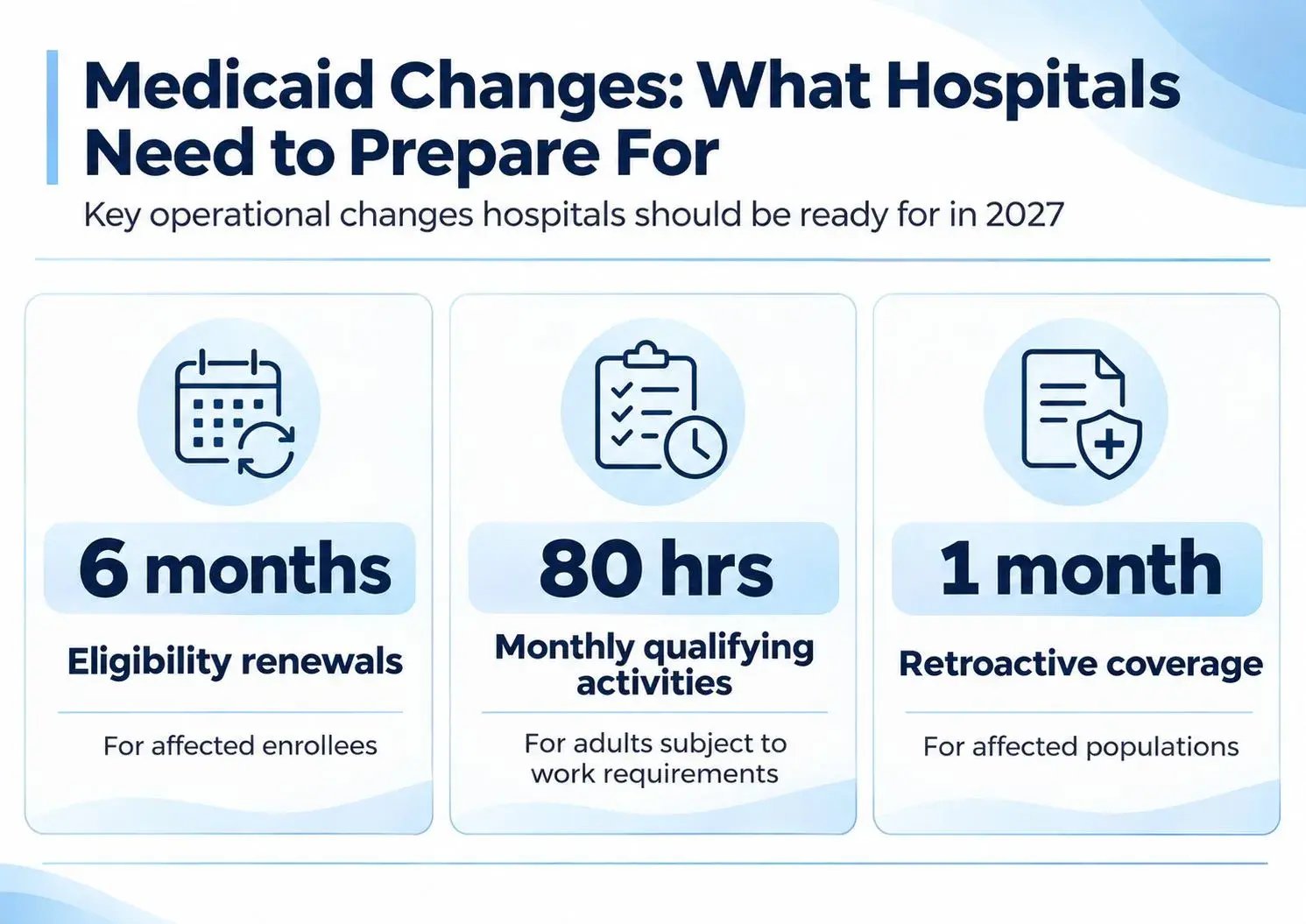
Starting January 1, 2027, millions of Medicaid patients will have to show proof of eligibility twice a year instead of just once, which has been the standard. Many will also have to show that they work, go to school, or volunteer for 80 hours a month. The retroactive coverage window, which lets a hospital get paid for care provided before a patient enrolls in Medicaid, is shrinking from three months to one for many of these same patients.
These new rules are expected to cause a lot of current Medicaid patients to lose coverage, primarily because of paperwork snafus. Nebraska started its work requirements early, and the initial numbers foreshadow what’s likely to come elsewhere. According to an analysis from Georgetown University’s Center for Children and Families, 92% of Nebraska Medicaid enrollees who lost coverage at renewal did so because they didn’t send in information the state requested. Nationally, the Congressional Budget Office expects the new rules to leave 10 million more people uninsured by 2034, with 7.5 million of them tied to its Medicaid changes.
The fear of potential administrative and financial chaos is well-founded. Imagine a patient who was covered in March coming in for their next appointment in November, and then not being covered. And probably not even knowing it. If somebody doesn’t catch it at check-in, it will likely show up as a denied insurance claim and a self-pay balance weeks later. With the new one-month retroactive coverage window in effect, that leaves very little time for the patient and hospital to rectify the situation.
Thorough eligibility checks and short-staffed front desks aren’t a good combination. The checks take time and know-how, and a thin admin team may not be able to keep pace. Hospitals need to get ahead of what’s coming in January and beyond with enough trained people in place to check eligibility at every visit and catch lapsed coverage early, when it’s easiest to fix.
3. Catch Denials Before the Claim Goes Out
Payers are using AI to generate denials at high volumes, and it’s costing hospitals more every year. Kodiak Solutions, which tracks data from more than 2,300 hospitals, found that providers lost more than $48 billion to final denials and bad debt in 2025, up 25% from the year before. Nearly all of the increase in denial rates came from clinical denials, including claims missing a prior authorization. And in HFMA and Guidehouse’s 2026 survey of mostly hospital and health system finance leaders, 74% reported an increase in prior authorization delays.
The takeaway for hospitals is that many denials actually start upstream, long before the billing team gets their hands on them. In a 2026 Black Book Research survey, 76% of revenue cycle leaders linked front-end data quality directly to denials or payment timing.
For hospitals, especially the ones that can’t match payer AI with their own equivalent, mitigating denials begins early in the patient journey by double-checking benefits every visit, staying on top of pending prior authorizations, and having enough trained eyes on the details to catch something like a missing or incorrect member ID.
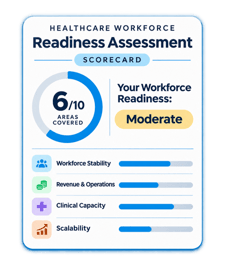
Is Your Hospital's Administrative Workforce Ready for 2027?
Staffing shortages, eligibility changes, and rising denials are putting hospital operations under pressure. Discover where your workforce may be falling behind with our free 3-minute assessment.
4. Pair Trained Professionals With AI
Of course, payers aren’t the only ones using AI. Hospitals are putting it to work as well, though it’s been a much slower build. In a February 2026 HFMA survey of healthcare finance leaders, 27% said their organizations are using AI at scale, and another 53% are running pilots. Those numbers are promising, but payers already using AI aren’t waiting for hospitals to catch up.
That’s a gap hospitals need to address right now, especially when it comes to administrative workloads. AI excels at doing repetitive tasks at machine speed, things like logging into payer portals and pulling eligibility data. In the administrative process, AI takes repetitive work off people’s plates so they can focus on high-level decision-making. A balance of both AI and human expertise is an ideal operational model.
Vera, GMVA’s AI platform, is a good example. Vera’s AI agents call insurance companies to verify coverage and confirm benefits while a trained GMVA professional monitors each call. Dot, Vera’s automation arm, gathers information for prior authorizations and prepares each one for a GMVA specialist to review and submit.
That should be the goal: technology and humans working together to make the whole administrative process faster and more effective.
5. Build a Development Plan for Admin Staff
In Experian’s 2026 survey, 39% of providers said insufficient staff training is making it harder for patients to get care. Add that to NSI’s first-year turnover figure of 29.5%, and you can see why it’s so difficult to find and keep enough full-time administrative staff to stay ahead of the work and serve patients.
Understandably, hospitals put a lot of resources behind keeping their clinical pipelines full, with residencies, tuition programs, and well-defined career paths for nurses and techs. Admin roles don’t get the same emphasis, which is also understandable. Typically, it’s hire, train, and repeat. But that’s not getting the work done anymore.
A real workforce development plan for the admin function brings the consistency hospitals have been missing for years, and gives permanent answers to the following questions:
• Who is doing the admin work?
• What are their qualifications?
• Who supervises the work and makes sure it meets the organization’s standards?
Having solid answers to those questions, regardless of how unpredictable the workload gets and how often full-time employees leave, is the idea behind workforce infrastructure. It’s the flexible workforce model hospitals should be adopting. Workforce infrastructure uses a team of trained professionals who work within a hospital’s systems and processes, but aren’t on its payroll, to keep administrative work covered. The hospital maintains full operational control over the work and how it gets done, which makes this an insourced approach, rather than outsourcing. With outsourcing, someone else is in command.
With sustainable infrastructure in place, a hospital’s admin function has room to adapt to change. When a full-time admin’s last day is Tuesday, the work still gets done on Wednesday while the open job gets reposted. When the workload increases, the team can grow to match it. Whatever the scenario, the administrative pipeline doesn’t slow down.
Working with a workforce infrastructure partner like GMVA is one way hospitals put that kind of insourced team in place. GMVA professionals are HIPAA-certified, and the company is one of only three in its space with Epic approval.
Capacity That Lasts
Getting through 2027 will take more than extra effort and overtime, and hospitals with built-in administrative capacity will be the ones that can protect internal workflows, deliver a positive patient experience, and collect revenue, even when the pressure rises.
If doing whatever it takes to get administrative work done is wearing thin, it’s time to consider a new, more versatile approach. Let’s talk about what workforce infrastructure might look like inside your hospital or health system. With this new model in place, nurses can stay focused on their patients, billing teams can go home on time, and the administrative work still gets done, no matter how much of it there is.
Contact us to explore how GMVA can help your hospital or health system build sustainable administrative capacity, strengthen operational efficiency, and prepare for the challenges ahead.